


Coffee Husk Pellets 5kg Bag
- Free UK delivery, dispatched within 24 hours
- 14-day returns on unopened bags
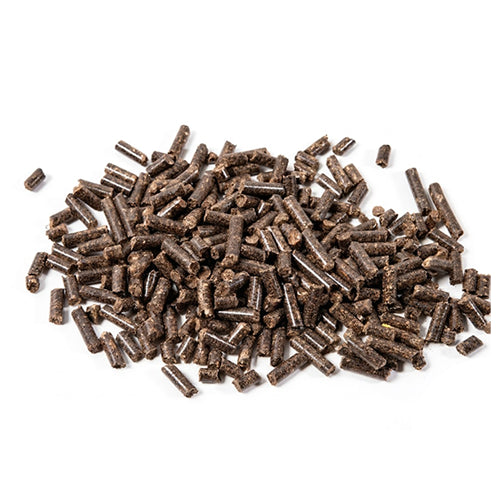
- 100% coffee husk. No trees, binders or glues
- Fits pellet stoves, boilers, ovens and grills
Couldn't load pickup availability
ABOUT THIS BAG
Five kilos. Try it properly before you commit.
The same pellet as the 15kg bag, in a smaller bag. This is the sensible way to find out whether COFFUEL suits your appliance and how you burn, without buying a full-size bag to find out.
COFFUEL is pressed from coffee husk, the dry outer layer left at the mill once the coffee bean is removed. No trees felled, no chemical binders, no glues. It is made to the standard pellet format, so it feeds through the same hoppers and augers as wood pellets.
What it works in
- Pellet stoves
- Pellet boilers
- Pellet pizza ovens
- Pellet grills and smokers
- Pellet-compatible fire pits
- Log burners and open fires, with a pellet basket
What it does not work in
- A traditional closed charcoal BBQ on its own. Pellets need continuous airflow and top-down ignition, and a closed BBQ does not provide it. Add a pellet basket and it can be used.
Full specification, ash figure and certification status are in the technical specification below. Produced with Garcabas in Colombia. Free UK delivery, dispatched within 24 hours Monday to Friday, 14-day returns on unopened bags.
What it works in, and what it does not
What it works in, and what it does not
Works in: pellet boilers, pellet stoves, pellet pizza ovens, pellet grills and BBQs, and pellet-compatible fire pits. Log burners and open fires only with a pellet basket.
Does not work in: a traditional closed BBQ on its own. Pellets need continuous airflow and top-down ignition, and a closed BBQ does not provide it. Add a pellet basket and it can be used. We would rather tell you here than refund you later.
How to light it
How to light it
No teepee, no kindling. Put one natural firelighter in the grate, basket or oven, cover it with a large handful of pellets, light it, and top up once the first layer is glowing through. Pellets ignite top-down and need airflow underneath, so keep them in a pile rather than spread out.
Storage and getting the best out of it
Storage and getting the best out of it
Keep the bag dry. Moisture is what makes any pellet swell and jam an auger, whatever it is made from. Store indoors or in a dry, ventilated space, off a concrete floor, and not in a damp shed.
Empty the hopper if you are not burning for a while. Pellets left sitting in a hopper pick up moisture from the air.
Expect more ash than a premium wood pellet. COFFUEL is 2% ash against roughly 0.7% for ENplus A1 wood. Plan on emptying the pan more often. The ash is alkaline and potassium-rich, so once it is completely cool it goes on general beds, vegetable plots or the compost heap. Keep it away from blueberries, rhododendrons, azaleas, camellias, heathers and hydrangeas, which all want acid soil.
Delivery
Delivery
Free UK mainland delivery on every bag. Dispatched within 24 hours Monday to Friday on a fully tracked service, typically 2 to 3 working days.
Pallets are different. Half and full pallets are priced on request, with freight quoted for your postcode. Use the Get a quote button on the pallet pages.
Ordering from outside the UK mainland? Email care@coffuel.co before you order so we can arrange logistics.
14-day returns
14-day returns
If you change your mind, send back any unopened bags within 14 days of delivery for a full refund of the purchase price. Email care@coffuel.co and we will arrange it.
Opened a bag and it is not for you? Tell us anyway. We would rather hear it and put it right than have you quietly not come back.


Works in
- Fireplaces, with a basketFireplaces, with a basket
- Pellet stovesStoves
- Pellet boilersBoilers
- Pellet pizza ovensPizza ovens
- Pellet grills & BBQsGrills & BBQs
- Pellet fire pitsFire pits
Not for closed charcoal BBQs without a pellet basket
If it burns wood pellets, it burns COFFUEL
Same standard size and shape as wood pellets, whatever the brand of your stove, boiler, oven or grill. No changes to your appliance, no settings to adjust, no rocket science.
The numbers, including the one that does not flatter us
The 5kg bag is the same pellet as the 15kg, in a smaller bag. Every figure here is reported by our production partner in Colombia and printed on the bag.
Why we publish the ash figure, and why we would keep it. Coffee husk leaves more ash than a premium wood pellet, so you will empty the pan more often. We would rather tell you than have you find out on your second burn. What the number does not show is that this ash is worth having: it is alkaline and rich in potassium and calcium, the same reason gardeners have always saved wood ash. Once it is completely cool, work it thinly into beds, the vegetable plot or the compost heap and it goes to work as a free soil conditioner. The husk heats your house, then feeds your garden, which is the whole point of the thing. Two real caveats: it raises soil pH, so keep it off acid-loving plants (blueberries, rhododendrons, azaleas, camellias, heathers and hydrangeas), and if your appliance manufacturer sets a maximum ash content below 2%, follow their guidance rather than ours.
Wood pellets need trees. Ours need a coffee harvest.
Most pellet fuel sold in the UK is pressed from timber. COFFUEL is pressed from the husk that comes off coffee beans at the mill: a by-product that already exists, in enormous volume, and mostly goes to waste.
Wood pellets are made from trees.
Demand for pellet fuel keeps growing and almost all of it is met by timber. Every bag is forest: felled, dried and pressed.
Coffee husk already exists. And it rots.
Coffee mills strip the husk off the bean and most of it is left to decompose, releasing methane, a greenhouse gas many times more potent than CO2. We dry it and press it instead.
A dense, dry, low-residue pellet.
Supplier-reported: 10% moisture, 2% ash, 4,797 kcal/kg. Dense, dry and low in residue.
Every figure on this site is supplier-reported and labelled as such.
Wood pellets vs coffee husk pellets
Same pellet format, different raw material. The facts as we have them, including the one that does not flatter us.
 Wood pellets
 COFFUEL coffee husk
Wood pellet figures are ENplus A1 thresholds. COFFUEL figures are supplier-reported.
How to light it
No teepee. No kindling. One firelighter.

1. One firelighter

2. A handful of pellets

3. Light it, then top up
Every size we make
Same pellet in every bag. Pick the size that suits how often you burn.
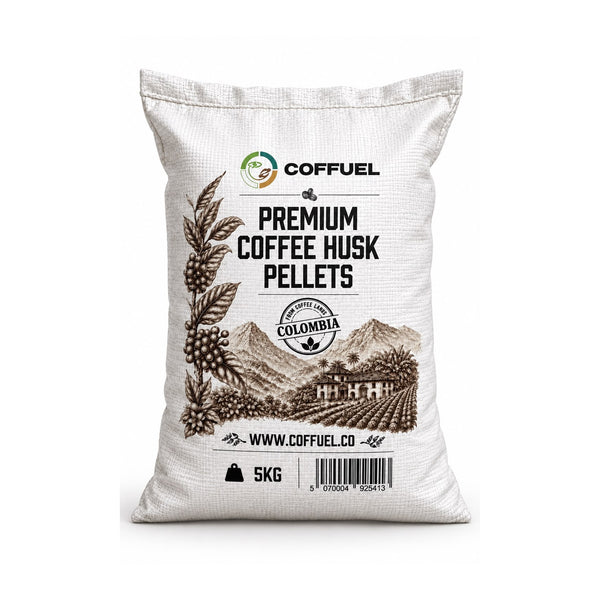
5kg Bag
Same pellet as the 15kg, in a smaller bag. Good for your first few fires.
- Free UK delivery
- 14-day returns on unopened bags

15kg Bag
The everyday bag for stoves, boilers, ovens and grills.
- Free UK delivery
- Dispatched within 24 hours, Mon to Fri
- 14-day returns on unopened bags
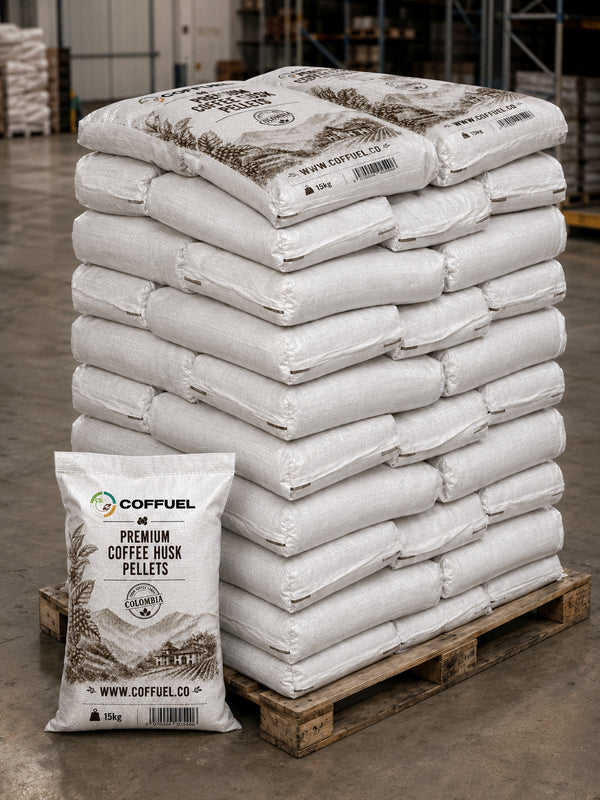
Pallets
Half pallet of 32 bags or full pallet of 65 bags. For trade, hospitality and big users, at a big discount on the bag price.
- Big trade discount vs single bags
- Half pallet: 32 x 15kg bags
- Full pallet: 65 x 15kg bags
- Freight quoted to your postcode
Free UK delivery on bags; pallet freight is quoted for your postcode.
FAQs
Everything worth knowing before your first fire. If your question is not here, email care@coffuel.co and we will answer it properly, including when the answer is no.
COFFUEL is produced to the standard pellet format, so it suits equipment built to burn pellets: pellet boilers, pellet stoves, pellet pizza ovens, pellet grills and BBQs, and pellet-compatible fire pits.
It is not suitable for a traditional closed charcoal BBQ on its own. Pellets use top-down ignition and need continuous airflow to establish, and a closed BBQ does not provide it. With a pellet basket, which holds the pellets together and lets air through, it can be used. We would rather tell you here than refund you later.
We do not claim compatibility with any specific manufacturer's appliance. If yours is designed to burn pellets, COFFUEL is designed to suit it, but always check your manufacturer's own fuel guidance first.
COFFUEL is pressed to the standard pellet format and dried to around 10% moisture, which is what keeps any pellet feeding cleanly. It runs through the same augers and hoppers as wood pellets.
Two honest caveats. Moisture is what makes pellets swell and jam, so keep the bag dry. And COFFUEL is 2% ash against roughly 0.7% for a premium wood pellet, so you will empty the ash pan more often. If your manufacturer sets a maximum ash content below 2%, follow their guidance.
It depends on your appliance and how hard you run it, and we are not going to invent a number we cannot evidence. What we can tell you is that a pellet stove on a moderate setting typically gets through roughly 1kg to 2kg an hour, so a 15kg bag is somewhere around 8 to 15 hours of burning. Treat that as the industry rule of thumb it is, not a COFFUEL measurement.
If you are new to COFFUEL, the 5kg bag is the easy place to start.
Yes, with a pellet basket. You do not need a pellet stove. Pellets are smaller and denser than logs, so loose in a grate they fall through the bars and cannot get enough air. A pellet basket, usually around £20 to £30, holds them together with air flowing through.
Sit the basket on your grate, pour the pellets in, light them from the top with a firelighter, and enjoy the fire as you would with logs.
If you live in a smoke control area, which covers most of London and many UK towns and cities, check your council's rules on what you can burn in an open fireplace before you light. Read our Clean Air Laws guide.
No. COFFUEL is made from the husk rather than the roasted bean, so it gives off a neutral, organic smell rather than a coffee one. It will not carry into your food when you cook with it.
Yes. COFFUEL is 100% organic coffee husk with zero chemical binders, glues or additives, so there is nothing in it that should not be near food. Use it in pellet-fuelled ovens, grills and BBQs.
Supplier-reported figures:
Calorific value: 4,797 kcal/kg gross (approximately 20.1 MJ/kg), 18.73 MJ/kg net
Moisture: 10%
Ash: 2%
Sulfur: 0.1%
Pellet length: 50mm
Chemicals and toxics: 0%
These are the figures reported by our production partner and printed on the bag.
Coffee husk ash is mineral-rich and alkaline, containing potassium, calcium and other minerals. Once completely cool it can be worked into garden soil or a compost heap.
One important caveat: because the ash is alkaline it raises soil pH, so do not use it around acid-loving plants. Blueberries, rhododendrons, azaleas, camellias, heathers and hydrangeas will all suffer. Use it on general beds, vegetable plots and compost instead, and spread it thinly.
Every bag ships free to the UK mainland. Bagged orders are dispatched within 24 hours Monday to Friday on a fully tracked service, typically 2 to 3 working days.
Half Pallet: freight calculated for your postcode at checkout. Full Pallet: quoted with your order. Pallet freight genuinely varies by destination, so we confirm the exact cost for your address rather than quoting a flat rate that might be wrong.
Ordering from outside the UK? Email care@coffuel.co before you order so we can arrange logistics.
Under the Environment Act 2021, local authorities in Smoke Control Areas can issue civil penalties of up to £300 for chimneys emitting substantial smoke, and the sale of wet wood and traditional house coal has been restricted. This is why dry, low-moisture fuels have replaced logs in a lot of homes.
COFFUEL is dried to around 10% moisture and is designed to burn dry with low smoke.
Do I need a Ready to Burn mark? No. COFFUEL is exempt from Woodsure "Ready to Burn" certification, and Ready to Burn confirmed this to us directly. For reference, the scheme's moisture limit is 20%; COFFUEL is dried to around 10% (supplier-reported). You should still check your own appliance and local authority requirements.
